
9 Key Benefits of a Restaurant POS System for UK Restaurants
Share This Story, Choose Your Platform!
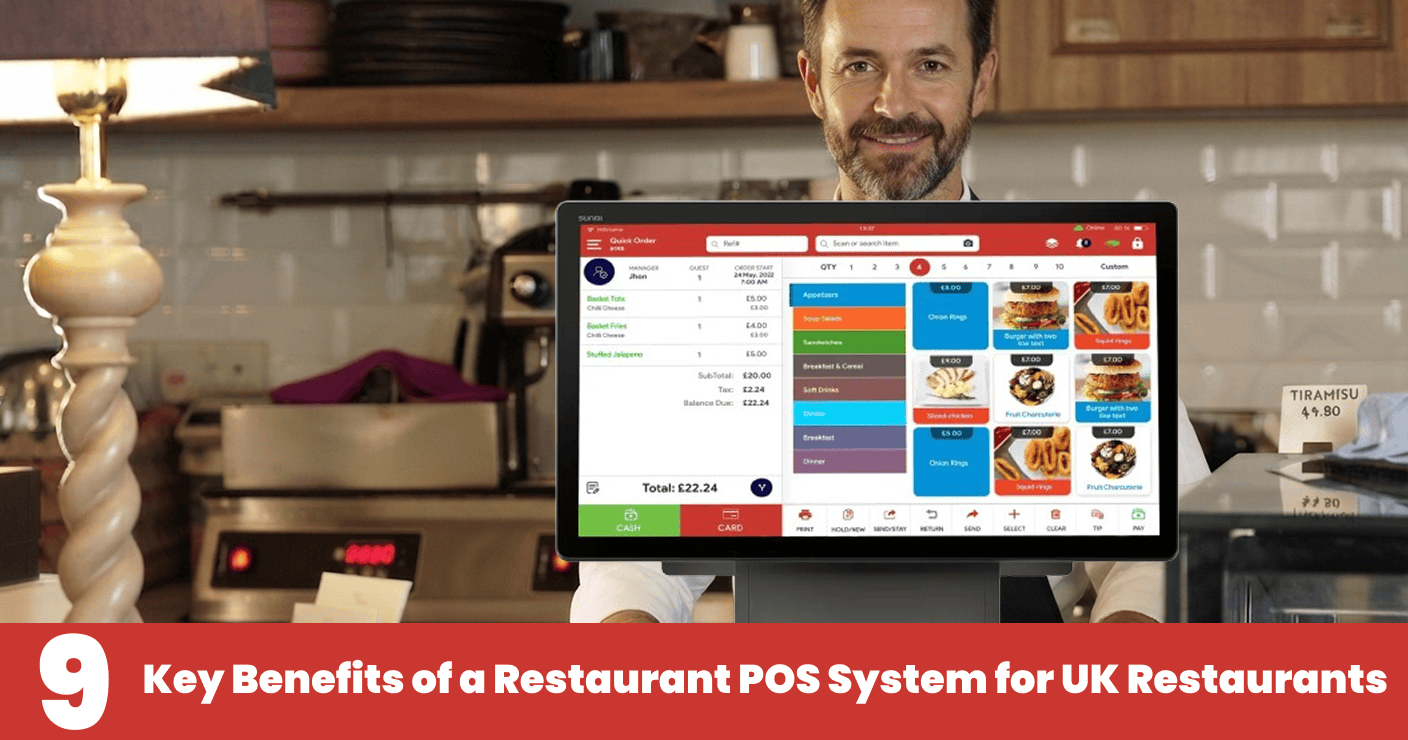
Table of Content
Quick Answer – A modern restaurant POS system helps UK restaurants centralize orders, payments, inventory, staff operations, and reporting in one platform. Key benefits include faster and more accurate order taking, easier VAT and sales record management, better order communication through modifiers and notes, real-time inventory tracking, centralized multi-location management, online ordering and delivery integration, faster staff onboarding, data-driven reporting, and flexible payment processing. These capabilities help restaurants reduce manual work, improve operational efficiency, and make better business decisions.
The UK restaurant industry runs on tight margins and even tighter timelines. In fact, the Office for National Statistics (ONS) reported that 61% of businesses in the accommodation and food service sector identified labour costs as a challenge to their business in August 2025
Between VAT rules, allergen disclosure requirements, and rising labour and rent costs, operators can’t afford a till that only takes payments. A restaurant POS needs to do far more: manage orders, payments, inventory, staff, and compliance all from one place.
If you’re still deciding whether a modern POS is worth the investment, this guide breaks down the 9 restaurant POS benefits that matter most for UK operators, from day-to-day efficiency to long-term profitability.
What Is a Restaurant POS System?
A restaurant POS system is software that manages restaurant orders, payments, inventory, staff operations, and reporting from a central platform. It is the technology hub that connects everything happening in your restaurant – including order-taking, kitchen communication, payments, inventory, staff management, and reporting into one platform.
A good restaurant POS doesn’t just replace a cash register; it acts as the operational backbone linking your front-of-house (FOH) and back-of-house (BOH) so that every order, payment, and stock movement is tracked in real time.
Restaurant POS Benefits: Quick Comparison
What Are the Key Benefits of a POS System for UK Restaurants?
1. Faster, More Accurate Order Taking
A modern restaurant POS helps staff take and manage orders accurately by supporting menus, modifiers, customization, and order- or item-level notes. With Quantic POS, orders are sent directly to the kitchen, while Quantic KDS displays tickets, special instructions, and customer notes for kitchen staff.
Orders route directly to the specific kitchen display system (KDS), eliminating manual errors and streamlining communication between FOH and BOH. The result is fewer mistakes, shorter ticket times, and a seamless guest experience, especially during peak service.
“According to UKHospitality research, self-ordering systems can make orders up to 40% faster than ordering at the counter. “
- Quick order entry means fast addition of orders, modifiers, and customizations.
- It provides direct kitchen routing, sending orders straight to the KDS.
- It displays the special notes and instructions, reducing manual errors.
- It allows better workflow by routing tickets to their dedicated kitchen stations.
2. Simplifies Tax and VAT compliance
UK-based hospitality businesses are required to keep accurate digital records and calculate VAT correctly on each sale. Quantic POS helps simplify VAT management by automatically applying the correct tax rate to each transaction and generating detailed digital reports.
Built-in reporting makes it easier to review sales data and share reports with your accountant, and keep your records organised and audit-ready throughout the year.
“In the UK, the standard VAT rate is 20%, although different goods and services can be subject to different VAT treatments.”
- It applies the correct VAT rate on each transaction
- It generates financial reports to simplify business analysis.
- It saves sales and tax data for long-term record-keeping, making it digitalized.
- It synchronizes the sales data with third-party integrations to streamline bookkeeping.
3. Supports Accurate Order Notes and Instructions
Restaurants need to communicate dietary preferences, special preparation, and any ingredient substitution requests. Quantic POS allows staff to add modifiers and order notes that are sent directly to the kitchen, ensuring these instructions are clearly visible on KDS tickets. This helps staff prepare orders accurately, reducing the risk of missed customer requests.
- It adds custom order notes for special and dietary orders.
- It displays special and dietary instructions to enhance kitchen communication.
- It provides menu modifiers for customization and substitutions.
- It reduces the chances of missing requests and provides clear details for each ticket.
4. Real-Time Inventory and Stock Control
Food cost is one of the biggest expenses for restaurants, making inventory management essential for profitability. Quantic POS updates inventory automatically when items are sold, tracks stock levels in real time, and sends low-stock alerts. With built-in inventory reporting and order management, it helps businesses make smarter purchasing decisions without affecting quality.
- It provides real-time stock tracking that keeps inventory updated.
- It provides inventory reports and data-driven insights for better stock planning.
- It sends low stock alerts, preventing unexpected stock shortages.
- It manages the purchase order and simplifies supplier ordering.
5. Centralised Multi-Location Management
For restaurant groups and franchises, a cloud-based POS keeps menus, pricing, and item descriptions consistent across multiple locations from a single dashboard. Quantic POS helps restaurants manage multiple locations with menus, pricing, and item descriptions.
Whether you’re updating a seasonal special or rolling out a price change, it changes everywhere at once so customers get the same experience no matter which branch they visit. It helps restaurants maintain consistency and streamline operations.
- It keeps the menus and item descriptions similar across all locations.
- It maintains similar product offerings and pricing across all locations.
- It also provides centralized pricing, which means it updates prices across linked locations.
- Restaurants can make menu changes from the parent location to all outlets.
6. Seamless Online Ordering and Delivery Integration
With takeaway and delivery now a significant part of UK restaurant revenue, integration with online platforms is no longer optional because it simplifies multi-channel management. A restaurant POS supports online ordering and integrations with delivery platforms that pull delivery orders directly into the same system as in-house orders, preventing double entry, reducing missed orders, and giving you one unified view of sales across all channels.
“The UK’s online food delivery market size grew from 16.6 billion British pounds in 2021 to 17.75 billion British pounds in 2023 and was forecast to reach nearly 28 billion British pounds by 2028.”
- It provides integrated online ordering that brings the orders directly to the POS.
- It provides a centralized sales view that helps restaurants view sales from multiple locations.
- It reduces manual entry and re-entering online orders.
- It supports third-party integrations with the delivery channel.
7. Faster Staff Onboarding and Reduced Training Time
Hospitality sees higher staff turnover than most sectors, and every new hire costs time and money to train. An intuitive POS interface makes it easier for new restaurants to learn essential tasks. Quantic offers a user-friendly interface designed to manage consistent workflow, order entry, and daily operations, so new staff can get up to speed in hours rather than days. It reduces training overhead and keeps service quality steady even during busy hiring periods.
- It provides a user-friendly interface that helps new employees use POS with less training.
- It simplifies the restaurant’s workflows, making the daily tasks easier.
- It helps in fast onboarding in hours rather than days.
- It also reduces the training costs and onboarding time.
8. Data-Based Decision Making
Beyond day-to-day operations, a modern restaurant POS can turn transaction data into actionable business insights. Quantic POS provides real-time reporting on sales trends, best-selling items, peak hours, and staff performance, helping restaurant operators to make data-driven decisions. This turns raw transaction data into business decisions: what to put on a combo deal, when to schedule more staff, or which menu items to retire. That kind of visibility is a genuine competitive advantage.
- It provides real-time sales data reports that include sales performance and revenue trends.
- It helps restaurants identify the best-selling items and least-selling items.
- It provides remote access that helps businesses to review essential business data.
- It tracks employee sales performance and provides staff reports.
9. Secure, Flexible Payment Processing
A modern restaurant POS should support multiple payment methods to help customers offer flexible checkout options. Quantic supports contactless and digital wallet payments, which continue to dominate customer preferences. Features such as Quick Charge and Scan & Pay options also speed up transactions for customers who want to pay and go without creating a complete profile, useful for quick-service restaurants and busy bars.
- It allows scan and pay, which helps customers provide self-service payment options.
- It provides contactless payment options and tap-to-pay transactions.
- It helps customers to provide self-service payment options.
- It supports mobile wallet payments such as Apple Pay.